
The Four Sexual Responses
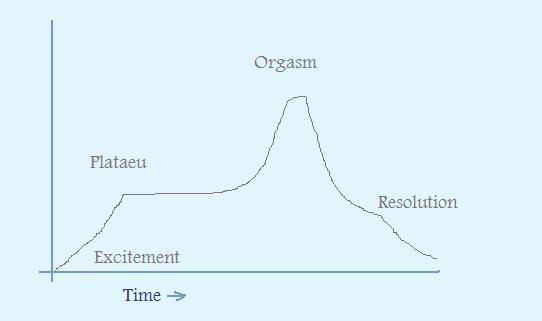
The sexual response cycle has four phases which both men and women will experience. It refers to a series of physical changes which arise through sexual stimulation as a person becomes aroused prior to coitus. Although the sexual response is essentially the same in both sexes, the male sexual response differs physiologically to the female. The model was developed by William Masters and Virginia Johnson in 1966, who were pioneers in their work on sexuality.
Within a single sexual experience the male will experience four distinct physiological phases (shown in the graph above). This cycle consists of:
1. Excitation - as the man becomes sexually aroused the blood vessels in the erectile tissue in his penis dilate causing it to become ridgid, the spermatic cords and muscles in the testicles contract and the skin thickens. The heart rate and respiratory rate increase as the phase continues.
2. Plateau - a continuation of the previous phase, the heart and respiratory rates increase even furthur and blood pressure rises. Rythmic contractions of the muscles at the base of the penis and the gathering of the spermatic fluid in the urethra marks the nearing of the orgasm.
3. Orgasm - The most obvious response is ejaculation as semen is expelled from the urethra
4. Resolution - as ejaculation ends the erection gradually disappears and the genitals experience a period of hypersensitivity, whereby no more stimulation will cause a response. The body is unable to regain the orgasm phase. This is known as the refractory period. Following this the body begins to return to its relaxed state.

All of these stages must be achieved in order for sexual intercourse to be mechanically viable, and correct penetration to occur. The image below shows the effects of sexual arousal on the male genitals. Notice how the penis increases in size by over 50% and the elevation of the testicles as the muscles in the scrotum contract.
---------------------------------------------------------------------------
References
All information about the sexual response cycle is sourced from:
- Masters, W.H.; Johnson, V.E. (1966). Human Sexual Response. Toronto; New York: Bantam Books.
- https://www.askdrkhaled.com/normal%20male%20sexual%20function/6The%20Male%20Response.htm
- The bottom image is sourced from flickr under the creative commons license agreement.
- All other images are hand produced.

